- Over the Hedge
- Posts
- Why Do You Make Bad Financial Decisions?
Why Do You Make Bad Financial Decisions?
The difference between perception and perspective

Carlo Dela Cruz
February 17, 2024
What is the difference between perception and perspective?
Perception is "a way of regarding, understanding, or interpreting something; a mental impression." On the other hand, perspective is "a particular attitude; a point of view."
In their new book, "It's NOT an OPTION" by Jon and Pete Najarian, they discuss how perception and perspective affect profits and losses. As an investor or trader, you must understand that risk is very fluid and how risk changes over time as stock price, volatility, and other factors change. As things change, you need to understand and be able to quantify how your risk changes as well. If not, you are not investing or trading. You are simply guessing.
Whereas hedging is second nature to professional traders, investors miss this point. It is not because of lack of understanding or discipline but one key reason -- differences in perceptions. You might think that you are managing risk when you are not. So let us consider a new field of psychology called Behavioral Finance -- the psychology of financial decisions -- also sometimes called Behavioral Economics to give us different perspectives on risk.
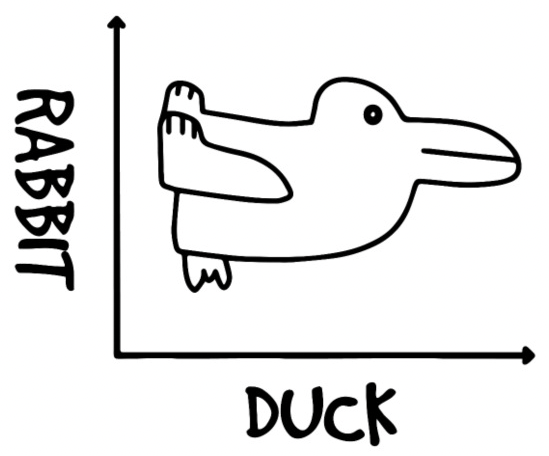
What do you see below? Do you see a rabbit, or do you see a duck? Risk works the same way. You might identify something as a risk, but it could be misperceptions about the problem. If you see the wrong problem, you will have the wrong solution, even if supported by elaborate and meticulous calculations.
Let us start with a problem that has nothing to do with stock investments and see how people shopping for cars with better mileage make bad judgments due to misperceptions. Suppose you are shopping for a new car, and you want to get better mileage. Your current car has 50 mpg, and the salesman offers you a 100 mpg car. Do you make the switch? It's a 100% improvement!
Here's another scenario: Your car gets 14 mpg, and offered one with 21 mpg. Do you take it?
Most people would switch in the first scenario but not the second. Do you agree? The additional 50 mpg in the first scenario is better than the seven mpg increase in the second scenario. It is obviously better to switch from a car that gets an additional 50 miles per gallon than one with seven, right?
Wrong! It might be obvious, but it is wrong.
Let us say that you drive 100 miles. The first scenario will save you one gallon of gas, but the second will save you 2.4 gallons. Your gas savings will be more than twice as much with the second car, but you turned it down. What happened?
You misperceived the problem: your goal was to get a more fuel-efficient car. You thought you needed to get more miles per gallon. But if you stop to think about it, what that is saying is you want to drive further on every gallon of gas. The real problem is to use fewer gallons per mile. It is not about high mileage but about low consumption. It sounds like they are similar problems, but they are not, and that is why it is easy to make the mistake.
The very thing you were trying to accomplish backfired. It is not because the math is hard but because of how you perceive the problem.
Editor’s Note:
Car makers now include "gallons per 100 miles" to help consumers make better decisions.